 Türkçe
 English
Embryo Freezing Turkey
What Is Embryo Freezing?
In IVF (in vitro fertilization) treatment, embryos remaining after the embryo transfer can be frozen and stored for future use. Depending on their number and quality, embryos can be frozen on either day 3 or day 5 of development.
If pregnancy is not achieved after the first embryo transfer, frozen embryos can later be thawed and transferred to the uterus in a subsequent cycle. This allows for continued chances of pregnancy without the need for repeated egg stimulation and retrieval procedures. Even if a pregnancy is achieved with the first transfer, having frozen embryos provides an opportunity for future pregnancies.
Who Is Embryo Freezing Recommended For?
We recommend embryo freezing for patients who have surplus embryos after an embryo transfer, to be used in future treatment cycles. In addition, embryo freezing is also performed when the embryo transfer must be canceled due to certain medical reasons, so the embryos can be preserved for use at a more appropriate time.
Situations where embryo transfer may be canceled and freezing becomes necessary include:
- When the patient develops or is at risk of developing Ovarian Hyperstimulation Syndrome (OHSS)
- In the presence of conditions such as polyps, fibroids, or hydrosalpinx (fluid accumulation in the fallopian tubes),which may reduce the chance of successful embryo implantation—freezing is done to allow time for these issues to be treated before transfer
- When progesterone hormone levels rise prematurely during the ovarian stimulation phase
Embryo freezing is also performed in cases where Preimplantation Genetic Diagnosis (PGD) is required, or when we plan to accumulate embryos (also known as embryo pooling) for patients with diminished ovarian reserve.
How Do We Decide Which Embryos to Freeze?
When a patient has multiple embryos, they are typically monitored until day 5 (blastocyst stage),and only those that reach this stage with good quality are frozen. This ensures that high-quality embryos are selected. If the number of embryos is low, freezing may also be done on day 3. To ensure high survival rates during thawing, it is important to freeze only embryos of good quality.
How Are Embryos Frozen?
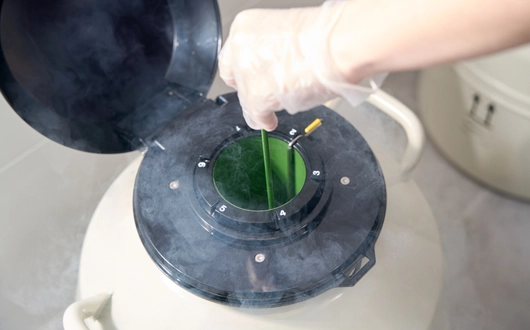
Just like with egg freezing, embryo freezing is done using the vitrification method, a rapid freezing technique. Embryos are stored in liquid nitrogen tanks at -196 degrees Celsius. With this method, embryo survival rates after thawing can be as high as 99%
How Long Can Frozen Embryos Be Stored?
According to the "Regulation on Assisted Reproductive Treatments" in Turkey, frozen embryos can be stored for up to 5 years with the written consent of both partners and by paying an annual storage fee to the freezing center. After 5 years, the storage period can be extended with approval from the Ministry of Health.
What Is the Success Rate of Frozen Embryo Transfer?
The pregnancy success rate after transferring high-quality frozen embryos is comparable to that of fresh embryo transfers, with clinical pregnancy rates around 60%.
How Is Frozen Embryo Transfer Performed?
Before thawing the frozen embryos, the uterus must be prepared to be receptive for embryo transfer.
This endometrial preparation can be done in several ways:
- With hormone replacement therapy (HRT),
- By tracking the natural ovulation cycle, or
- With ovulation induction medication in patients with irregular periods or ovulation problems.
All preparation protocols have similar success rates, and the most suitable one is chosen based on the individual needs of the patient.
What Is Embryo Culture?
After fertilization, embryo development is checked the following day.
- On day 3, embryos are referred to as cleavage-stage embryos,
- On day 5, they are called blastocysts.
A cleavage-stage embryo typically contains 8–10 cells, while a blastocyst consists of hundreds of cells, making individual cells no longer countable. At the blastocyst stage, the structures that will form the baby and the placenta begin to differentiate.
How Is the Quality of Cleavage-Stage (Day 3) Embryos Assessed?
On day 3, embryo quality is determined by:
- The number of blastomeres (cells),
- The uniformity of blastomere size, and
- The percentage of fragmentation (presence of cell debris).
Embryos with 7–8 cells, evenly sized blastomeres, and minimal fragmentation are considered high quality. Embryos are graded based on these criteria.
When there are many embryos, we often choose to cultivate them to the blastocyst stage to better select those with the highest implantation potential. During this period, embryos are periodically removed from incubators and evaluated under a microscope.
With Time-Lapse incubators, embryos can be continuously monitored without removing them from the environment. This allows detailed assessment of division rates and developmental quality.
How Is the Quality of Blastocyst (Day 5) Embryos Assessed?
A blastocyst consists of:
- The inner cell mass (ICM) that will become the baby, and
- The trophectoderm, the outer layer that will form the placenta.
A high-quality blastocyst typically contains around 300 cells. They are graded based on:
- The degree of expansion, and
- The appearance of the inner and outer cell layers (e.g., 4AA, 5AB, 5BB).
Which Day 5 Embryos Are Considered High Quality?
Embryos graded as 3AA, 4AA, 5AA, as well as 3AB, 4AB, 5AB, and 3BB, 4BB, 5BB are generally considered high-quality blastocysts. If an embryo is still at stage 3 or earlier on day 5, it is advisable to wait one more day and reassess on day 6. If it reaches the desired quality by then, it can be frozen at that stage.
Are Pregnancies Achieved Through Frozen Embryo Transfer Different From Natural Pregnancies?
In pregnancies resulting from frozen embryo transfer, the incidence of macrosomia (larger-than-average babies) has been found to be slightly higher.
However, when comparing pregnancies achieved through frozen embryo transfer, fresh embryo transfer, and natural conception, the risk of congenital anomalies has been found to be similar across all groups.


 About Me
 Contact