 Türkçe
 English
Egg Freezing in Ankara, Türkiye
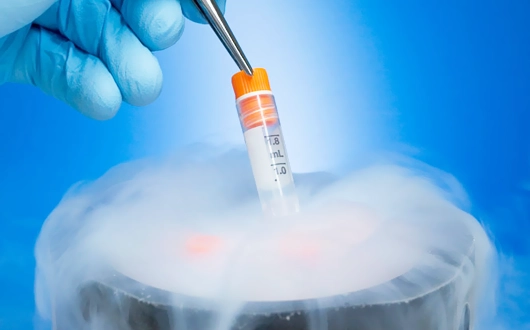
Egg Freezing
Women are born with a finite ovarian reserve, which is gradually depleted until menopause. While the use of certain vitamins and antioxidants may help improve egg quality and mitochondrial energy, ovarian reserve itself cannot be increased with medications.
Today, many women postpone marriage and pregnancy due to career planning, which increases the risk of age-related decline in fertility. In some cases, genetic diseases, treatments such as chemotherapy or radiotherapy, or surgeries involving the ovaries may also reduce ovarian reserve, causing fertility problems even at a young age.
Egg freezing should be strongly considered for women with diminished ovarian reserve, those who wish to postpone pregnancy to later ages, or those who are expected to undergo treatments that may reduce ovarian reserve.
What Is Egg Freezing?
Egg freezing is a procedure in which eggs that have matured following ovarian stimulation with fertility medications are retrieved through an egg collection procedure, and the mature eggs are then frozen and stored for future use.
Who Is Eligible for Egg Freezing?
In Türkiye, the conditions for egg freezing are regulated by the “Regulation on Assisted Reproductive Treatment Practices and Assisted Reproductive Treatment Centers.” According to this regulation, egg freezing may be performed in the following cases:
- Prior to treatments such as chemotherapy or radiotherapy that may damage gonadal cells,
- Before surgeries that may result in loss of reproductive function (such as removal of the ovaries or ovarian cyst surgery),
- In women with low ovarian reserve who have not yet given birth and do not plan to conceive in the near future, or in those with a family history of early menopause.
Egg freezing can be performed provided that the medical indication is documented with a health report signed by three specialist physicians.
Who Is Egg Freezing Recommended For?
Ovarian reserve gradually decreases from birth until menopause and cannot be increased with any treatment. Annual routine gynecological examinations are therefore important not only for general women’s health, but also for evaluating ovarian reserve and for the early detection of a possible decline.
Egg freezing should be recommended for women whose ovarian reserve is low for their age or who have a family history of early menopause, especially if they do not have plans for pregnancy in the near future. Likewise, egg freezing should be advised before treatment in patients who are scheduled to undergo ovarian surgery or who need to receive chemotherapy or radiotherapy.
The eggs collected through egg freezing can later be thawed at a time suitable for the patient and used for fertilization through intracytoplasmic sperm injection (ICSI),as part of in vitro fertilization (IVF) treatment.
What Is Diminished Ovarian Reserve?
The ovarian reserve is at its highest during the 20th week of fetal life, reaching approximately 6–7 million eggs. This number decreases to 1–2 million at birth and to around 200,000–400,000 by puberty. Thereafter, ovarian reserve continues to decline with age, with a more rapid decrease after the age of 35. Menopause occurs when the ovarian reserve is completely depleted.
Several tests are used to assess ovarian reserve. These include measuring FSH and estradiol (E2) levels on the 3rd day of the menstrual cycle, or measuring AMH (anti-Müllerian hormone) at any point during the cycle. Ovarian reserve is considered low when FSH levels are between 10–15 mIU/mL, E2 levels exceed 80 pg/mL, or AMH reopening is below 1 ng/mL.
Another important test is the antral follicle count, which is measured by ultrasound on the 3rd day of menstruation. This count reflects the number of follicles measuring 2–9 mm in diameter in both ovaries that are ready to grow during that cycle. An antral follicle count below 5–7 also indicates diminished ovarian reserve.
How Is Diminished Ovarian Reserve Diagnosed?
Diminished ovarian reserve may be suspected in patients who report menstrual irregularities. A normal menstrual cycle typically occurs every 27–28 days, and cycles ranging from 21–35 days are considered normal. Menstrual cycles that are shorter or longer than this range warrant hormonal evaluation.
The diagnosis is confirmed through blood tests and ultrasound examination. On the 3rd day of the menstrual cycle, ultrasound is used to count antral follicles measuring 2–9 mm in diameter. A diagnosis of diminished ovarian reserve is made when the antral follicle count is below 5–7, FSH levels are 10–15 mIU/mL or higher, E2 levels exceed 80 pg/mL, and AMH levels are below 1 ng/mL.
What Are the Steps of Egg Freezing Treatment?
The first stage of egg freezing treatment, similar to IVF, is ovarian stimulation. Injectable medications administered subcutaneously are used to stimulate the growth of all follicles that are ready to develop. In patients with diminished ovarian reserve, particularly those of advanced reproductive age, higher medication doses may be required.
When at least three follicles reach a size of 17 mm or larger, a trigger injection is administered, and eggs are retrieved 34–36 hours later. The egg retrieval procedure is the same as in IVF treatment. Under mild anesthesia, follicles containing egg cells are accessed via a needle guided by transvaginal ultrasound, and their contents are aspirated. The follicular fluid is then sent to embryologists for examination.
After evaluation, mature eggs are frozen using a rapid freezing technique (vitrification). When the patient later decides to marry or pursue pregnancy, the eggs can be thawed and used for fertilization.
How Is Egg Freezing Performed?
Eggs obtained through the egg freezing process are examined under a microscope, and mature eggs are frozen using a rapid freezing technique called vitrification. They are then stored in liquid nitrogen tanks at −196°C. When desired, the eggs are thawed and used for fertilization as part of in vitro fertilization (IVF) treatment.
Which Technique Is Used in Egg Freezing?
Today, egg and embryo freezing procedures are performed using the vitrification method, also known as rapid freezing. Compared to slow freezing, vitrification results in a higher survival rate of eggs after thawing, which is why it is the preferred method in current practice.
What Should Be Considered During the Egg Freezing Process?
Patients undergoing egg freezing usually have a reduced ovarian reserve, so the main goal is to obtain the highest possible number of eggs. For this reason, it is crucial to carefully analyze the patient’s characteristics and medical history and to determine the most appropriate treatment protocol and medication dosage. In this patient group, the risk of premature ovulation is relatively high; therefore, follicular monitoring must be performed meticulously, and the timing of the trigger injection should be carefully planned based on hormone levels.
Egg Freezing Costs 2026 Ankara, Turkey
Egg freezing costs in 2026 are expected to range between 70,000 and 90,000. This fee generally includes follow-up examinations, blood tests, egg retrieval, and freezing procedures; however, medication costs are not included.
What Is the Minimum Number of Eggs Targeted in Egg Freezing?
For egg freezing to be effective and successful in preserving fertility, the goal is to freeze at least 10 eggs. In patients with a low ovarian reserve, it may not always be possible to obtain this number in a single egg retrieval cycle. In such cases, repeated egg retrieval and freezing cycles should be performed until a minimum of 10 eggs is achieved.
What Tests Are Required Before Egg Freezing?
After the decision to proceed with egg freezing, compliance with the relevant regulations must be documented by a medical report signed by three specialist physicians before starting ovarian stimulation treatment. Treatment begins after this three-signature report is obtained. Additionally, before freezing the eggs following egg retrieval, DNA identification is performed using a blood sample taken from the woman.
What Should Be Done During the Preparation Phase Before Egg Freezing?
In patients with a low ovarian reserve, especially those over the age of 35, the use of antioxidant supplements can be beneficial in improving egg quality and mitochondrial energy. In addition, quitting smoking and alcohol consumption, losing excess weight, and engaging in regular physical activity are important. As with all treatments, maintaining a healthy lifestyle increases the success of egg freezing.
Is the Egg Freezing Procedure Risky? Are There Any Side Effects?
Egg freezing is a procedure that requires experience both during the egg retrieval and the freezing stages. Correct selection of medication dosages is essential to stimulate the maximum number of eggs; proper timing of the trigger injection is crucial to prevent premature ovulation and ensure egg maturation; and technically accurate egg retrieval is important both for maximizing egg yield and for preventing injury to surrounding organs.
Are Eggs Damaged During the Thawing Process?
Eggs frozen using the vitrification method are removed from liquid nitrogen tanks and thawed at room temperature. The survival rate of thawed eggs is approximately 99%. Fertilization (intracytoplasmic sperm injection, ICSI) is then performed on the eggs that survive thawing in good condition.
What Are the Benefits and Advantages of Egg Freezing?
Egg freezing is a highly effective method for preserving fertility in women with a family history of early menopause, those who postpone pregnancy to later ages, patients who will undergo ovarian surgery, or those who are planned to receive fertility-damaging treatments such as chemotherapy or radiotherapy.
What Are the Advantages of Egg Freezing?
Egg freezing can be considered a treatment option that essentially “stops time” for a woman. In this way, the negative effects of advanced age or treatments such as surgery and chemotherapy that may harm the ovaries on ovarian reserve and egg quality can be prevented.
With egg freezing, embryos created from eggs frozen at a younger age and fertilized later in life have a chromosomal abnormality risk comparable to that of younger ages. Moreover, the chance of pregnancy may continue even after menopause.
What Is the Success Rate of Egg Freezing?
With rapid freezing (vitrification),the post-thaw survival rate of frozen eggs is approximately 90–95%. Pregnancy rates achieved with embryos created from thawed and fertilized eggs are similar to those of routine IVF treatments.
Which Doctor Should Be Consulted for Egg Freezing?
As with IVF treatments, egg retrieval should be performed by a gynecologist and obstetrician who holds a certification in assisted reproductive technologies. In addition to certification, clinical experience is also essential for successful treatment outcomes.
Is Egg Freezing Legal?
In Türkiye, eggs can be legally frozen for patients who meet the conditions specified in the regulation issued in 2014, provided that a medical report signed by three physicians is obtained. DNA identification is performed prior to egg freezing. According to the regulation, eggs can be stored for up to 5 years with the patient’s consent. For longer storage periods, approval from the Ministry of Health is required.
When Can Daily Life Be Resumed After Egg Freezing?
Since egg retrieval is performed under anesthesia, resting on the day of the procedure is recommended. Due to the effects of anesthesia, driving is not advised on the same day. From the following day onward, patients can generally return to daily activities and work.
How Many Years Can Frozen Eggs Be Stored?
According to the Regulation on Assisted Reproductive Treatment Practices, frozen eggs can be stored for up to 5 years. A signed consent form must be submitted each year to continue storage. If longer storage is desired, it may be extended with additional approval from the Ministry of Health.
What Is the Ideal Age for Egg Freezing?
The younger the age at which egg freezing is performed, the better the quality of the retrieved eggs. Since ovarian reserve decreases with age, performing the procedure at an earlier age allows for the collection of a higher number of eggs. A greater number of high-quality eggs increases the likelihood of pregnancy.
Can Egg Freezing Be Performed in Single Women?
In Türkiye, egg freezing can be performed in single women who meet the conditions specified in the regulation. In single patients, vaginal egg retrieval is generally preferred due to its lower complication rate; however, transabdominal egg retrieval may also be performed when necessary.


 About Me
 Contact